IKA SCREW Guide & Tips: Boxes, Tray and Special Screws
IKA SCREW is a puzzle where you pull colorful screws out of stacked plates and drop them, 3 at a time, into boxes of the same color. It's easy to pick up since all you do is tap, but as you go, plates pile up and the order you pull screws in starts to matter a lot. Here, as the makers at IKA LAB, we explain how the game actually works: where each screw goes, how to protect the waiting tray, how to read stacked plates, the four special screws, the praise words, and how modes and IQ work.
Where a screw goes: box first, tray if there's no box
When you tap a screw, its destination is decided right away. If either of the two boxes at the top is the same color and still has room, the screw flies into that box. If neither box matches, it goes to the waiting tray just below. Each box holds 3 screws. Once it has 3, the Chibi Squid holding it carries it up and away, and the next box arrives in the same spot.
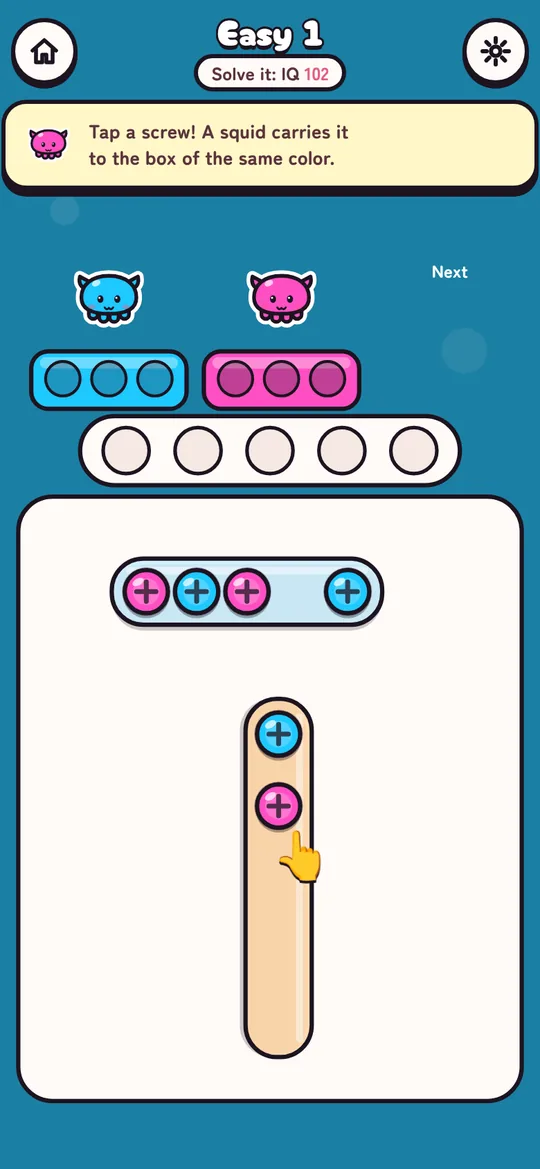
"Next" at the top right shows the colors of up to 3 upcoming boxes. The number of boxes in a stage is exactly one third of its screws, and every color comes in a multiple of 3. Pull out every screw and empty the tray to clear the stage.
In Easy stages 1 to 3, a short explanation appears above the board. In stage 1, a finger points at a screw that can go into a box right now, so tap where it points and watch how screws fly. When you tap between screws that sit close together, the game prefers the one that isn't covered by a plate.
The waiting tray: 2 slots left means caution
The tray has 5 slots. When only 2 are free, it turns yellow, and with 1 or none free it turns pink and blinks. Screws in the tray move into a box on their own as soon as a box of their color arrives, so using the tray isn't bad in itself. What to watch out for is filling it with colors that won't show up in "Next" for a while.
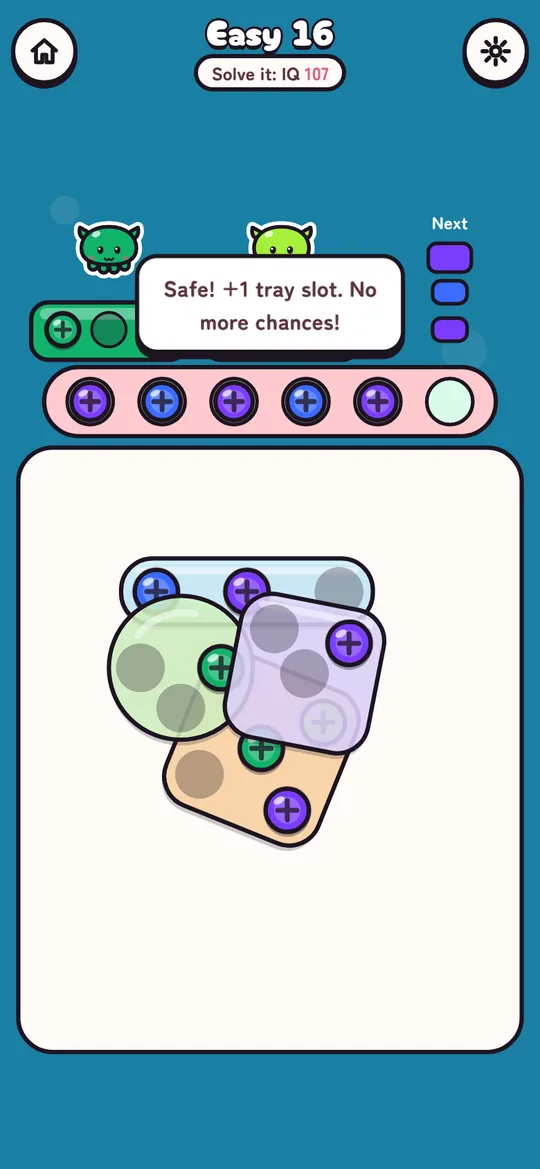
While the tray is full, you can only pull screws that match the current boxes. Tap any other screw and you'll see "The tray is full!" If there's no screw left that you can pull, you lose. The first time this happens in each stage, though, you get "Safe! +1 tray slot. No more chances!" and the tray grows to 6 slots. The second time, the "All full!" card appears, and "Retry" starts the stage over.
Before sending a screw to the tray, get in the habit of checking where its color sits in "Next." A color that's coming soon can wait in the tray, but a color you can't see yet is safer to leave alone until you run out of other moves.
Reading stacked plates: even a touching edge blocks a screw
Plates are stacked, and if another plate overlaps a screw even a little, that screw can't be pulled. Even a plate edge just grazing the screw blocks it, so be careful with screws that look like they're barely clear. Tap a blocked screw and you'll see "A plate is on top!" while the edge of the plate in the way flashes red.
A plate falls once every screw in it has been pulled. Every plate has at least one screw, so clearing plates from the top down gradually frees the screws below. Plates with only a few screws fall in just a few taps, so they're worth going after first when a color you need is hidden underneath.
Tapping a blocked screw counts as a miss, and it also breaks the praise streak we'll explain below. Check which plate is on top before you tap.
How to free the four special screws
Ice screws are wrapped in ice with a number on it. Each time you pull any other screw, the number on every ice screw on the board goes down by 1, and the ice melts at 0. Screws sent to the tray count too, not just the ones that go into boxes. The highest number is 3 in Easy, 4 in Normal and 5 in Hard.
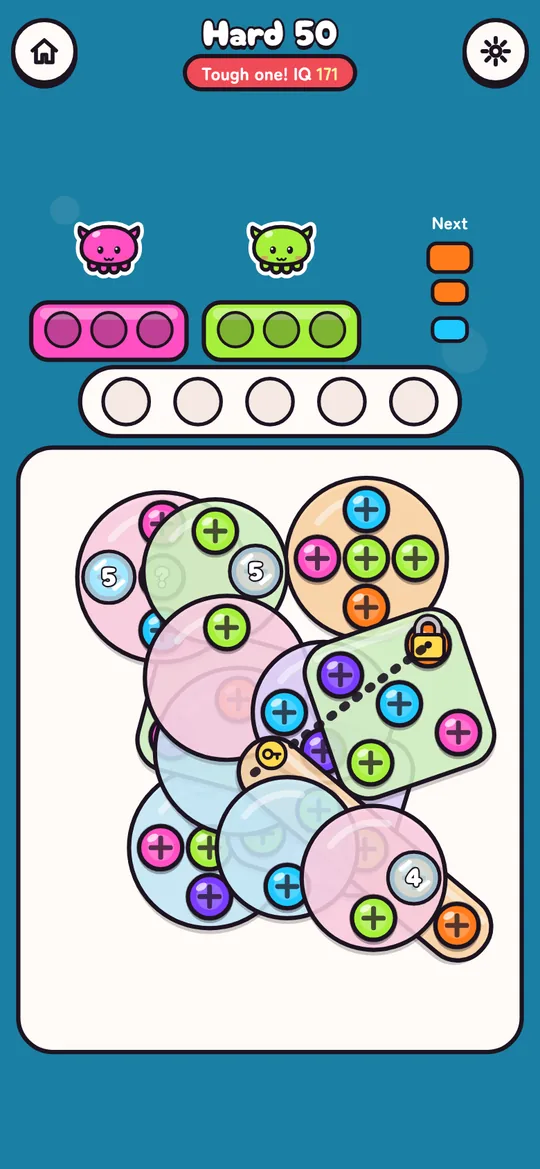
A "?" screw is a gray "?" while a plate covers it, so you can't see its color. Once nothing covers it, its real color appears. Since you can't pull it while it's covered, you'll never pull one without knowing its color.
A screw with a yellow padlock opens once you pull the screw with the key mark that's linked to it by a dotted line. A screw with a gray padlock is chained to 2 or 3 other screws, and it comes free once you pull all of them. Tap them too early and you'll see "Pull out the key screw first!" or "Pull out the chained screws first!" Tapping ice or padlocked screws doesn't count as a miss.
In Easy, ice screws first appear at stage 8, "?" screws at 40, keys at 120 and chains at 200. In Normal, it's ice at stage 1, "?" at 2, keys at 20 and chains at 50. In Hard, ice and "?" screws appear at stage 1, chains at 2 and keys at 5. Each stage has at most 1 kind of special screw in Easy, 2 in Normal and 3 in Hard. The first time a special screw appears, an explanation shows above the board, and once you clear that stage it won't show again.
Praise climbs every time a box leaves
Each time a box fills with 3 screws and leaves, the praise climbs one step: "Squid-cool!", "Squid-tastic!", "Ink-credible!", "Squid genius!", "Squid legend!" Seven in a row fills the screen with sparkles. The streak starts over when you tap a blocked screw, tap while the tray is full, or get a "Safe!"
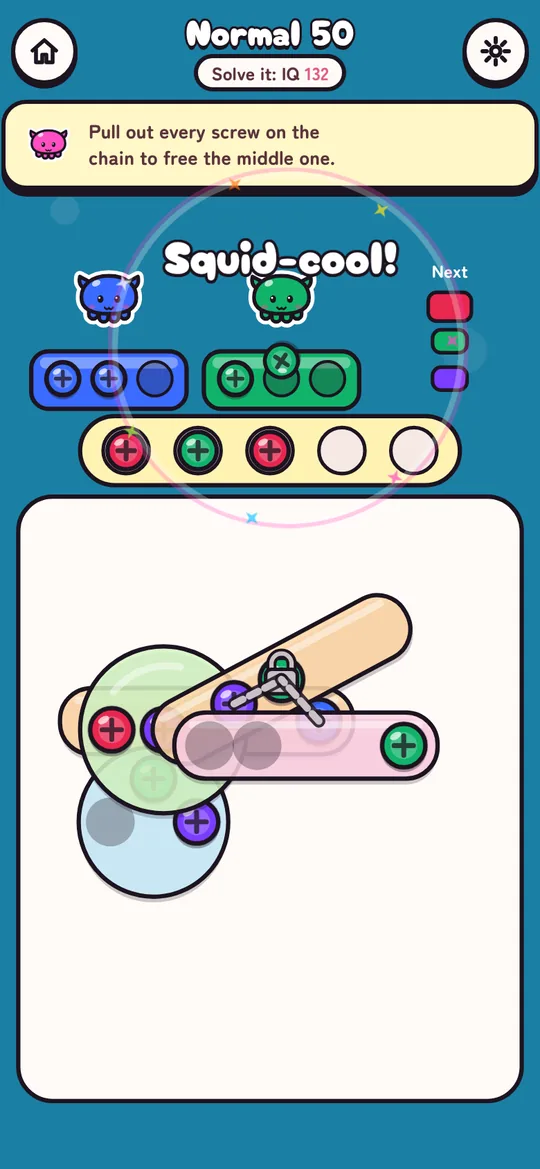
When the last box of the stage leaves and you haven't made a single miss or used the safe, you get "Squid-perfect!" Tapping ice or padlocked screws doesn't break the streak, so if you're going for it, you only need to watch the top plates and the free slots in the tray.
Unlocking modes, Tough stages and IQ
There are three modes, Easy, Normal and Hard, with 300 stages each. Clear 50 stages in Easy to open Normal, and 50 in Normal to open Hard; a "Normal mode unlocked!" card lets you know. Locked modes show 🔒 and a note like "Clear 50 Easy." Press "Start" and you begin at the stage after the furthest one you've cleared in that mode.
Easy stages have 6 to 33 screws in 2 to 5 colors, Normal 18 to 36 screws in 4 to 6 colors, and Hard 27 to 42 screws in 5 to 7 colors. Every 10th stage is usually a Tough stage, and the tag under the stage name turns red and reads "Tough one! IQ…" The exceptions are the stages that introduce special screws (Easy 40, 120 and 200, and Normal 20 and 50), which are regular stages.
The "Solve it: IQ…" tag rises as you go. In Easy it goes from 102 at stage 1 to 135 at stage 300, in Normal from 122 to 155, and in Hard from 152 to 195. Tough stages add 5. Clear stage 300 and you'll see "You cleared all 300. You’re a screw master!"


