IKA GUARD Advanced Guide: Late-Game Ink, the Five Enemies and the Boss's Rams, Currents and Tide Signals, Squid-perfect! and Records, Bonus and Daily
Our strategy guide covered where you can't draw, how much ink you get, the five shady squids, the three ways to lose and each chapter's gimmicks. In this advanced guide, we, the makers at IKA LAB, go one step further using only what we checked in the game's own code: what gets harder in the later chapters, how the enemies and the boss move, what sea currents and tide signals really do, how praise words and records are decided, and how Bonus and Daily stages differ.
Later chapters give you less spare ink
Our strategy guide said that from stage 11 on, your ink is about 1.17 to 1.7 times the length of the hint line. Chapter by chapter, that margin slowly shrinks: about 1.47 to 1.7 times in chapter 2, 1.4 to 1.45 in chapters 3 and 4, 1.3 to 1.35 in chapters 5 and 6, 1.23 to 1.28 in chapters 7 and 8, and 1.17 to 1.22 in chapters 9 and 10. Late in the game you can only draw about 20% more than the hint, so a line that takes the long way around runs out of ink. Covering Chibi Squid with a short dome or roof is the fastest route.
Defense time also gets longer. Chapter 1 asks for 8 to 12 seconds, but from stage 81 on, even regular stages last 10 to 12 seconds. Boss stages last 12 seconds on stage 10, 14 seconds on stages 20 to 60, and 15 seconds on stages 70 to 100. With 5 seconds left, a sound plays every second and the view slowly zooms toward Chibi Squid and the nearest shady squid.
Stages where you draw two lines are 71 to 80, plus 83, 86, 94, 97, 98 and 100. After your first line, nothing falls until you finish the second; then both fall together. You can't draw the second line right next to the first, so you can't stack them into one thick line. Stage 99 has two Chibi Squids but only one line.
The five shady squids, by the numbers
If a normal shady squid's top speed is 1, the fast one is about 1.55 and a little smaller. The heavy one is slow at about 0.58, but it weighs about 4.7 times as much as a normal one and is 1.5 times bigger. The sticky one moves at 0.8 and doesn't bounce off your line. The hopping one falls with gravity and leaps toward Chibi Squid about every 0.77 seconds.
When defense time starts, enemies come out of each shell one at a time, about every 0.12 seconds. If a shell holds two types, such as fast and normal, they take turns.
A sticky shady squid that touches your line during defense time sticks to that spot. Each one adds the weight of about 33 pixels of ink line (the board is 360 pixels wide) right where it sticks. If many gather near one end of the line, the line tilts that way.
Ink splash reaches 40 pixels from where you tap, plus the size of the enemy. It pushes heavy ones only half as hard, and the boss only 0.3 times as hard. It can't peel a sticky squid off your line.
On boss stages, read the rhythm of the rams
The boss appears from a fixed spot as soon as your line has fallen and defense time begins. You can't draw within 40 pixels of that spot. The boss weighs 4, more than Chibi Squid's 3, and it is 2.6 times the size of a normal shady squid.
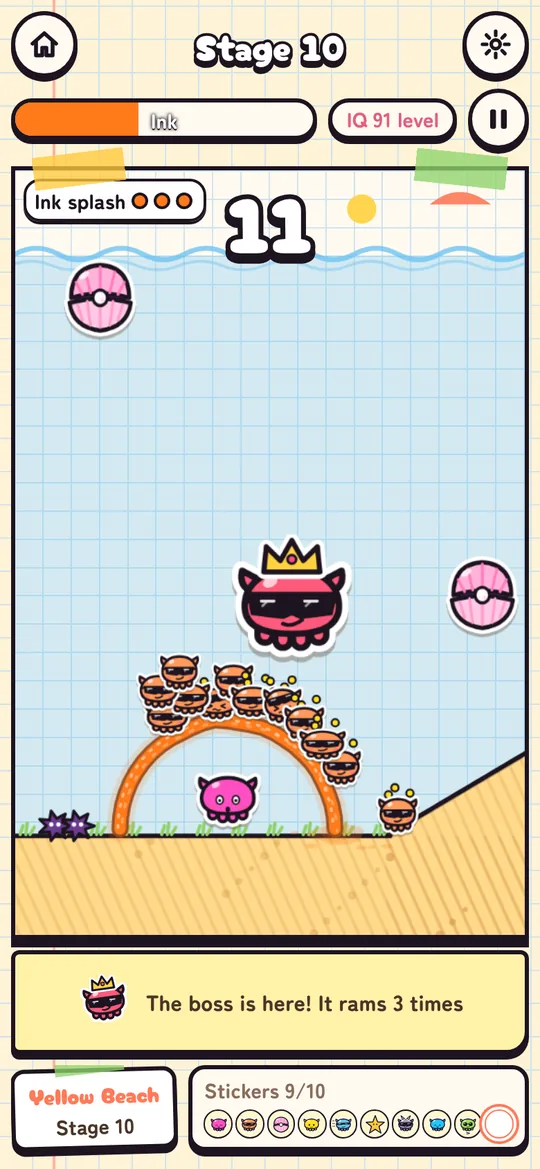
The boss always moves in the same order. It approaches Chibi Squid for about 1.2 seconds, almost stops for about 0.4 seconds to wind up, then rams for about 0.4 seconds at more than three times its normal speed. After that it takes about 0.8 seconds to go back to where it came from. For the second and third rams, it approaches for about 0.8 seconds before winding up.
The direction of each ram is set when the wind-up ends, toward the nearest Chibi Squid, and it doesn't curve on the way. After the third ram, the boss flies back up and leaves. If nothing pauses it, the third ram is over about 7 seconds after defense time starts (on stage 90 the tide signal pauses it, so it takes longer). Boss stages last 12 to 15 seconds, so after that you just need to hold off the shady squids from the shells to clear.
Inside currents, tide signals and moving platforms
A sea current only flows during defense time. It doesn't flow during the 0.6 seconds while your line falls. Your ink line is pushed the hardest; Chibi Squid gets about a third of that, and shady squids only a little. Each stage has its own direction, and on Bonus stages it is reversed left to right.
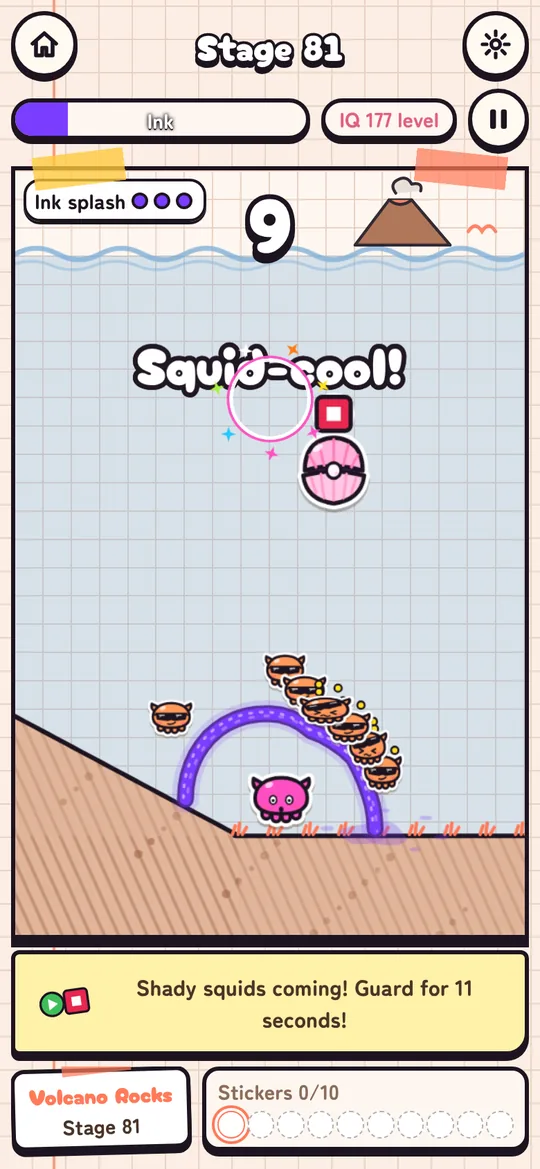
The tide signal repeats “▶ Go” for 2 seconds and “■ Stop” for 1 second, shown above the shells. During ■, shady squids almost freeze in place and hopping ones don't fall. The boss stops too. But the defense countdown keeps going. Your line and Chibi Squid don't stop either, so on stages with a current (93 and 96) they keep drifting during ■.
Moving platforms stay still while you draw and start moving once your line begins to fall. You can't draw on or right next to a platform, so to put a line on one, draw a little above it and let it drop.
Five praise steps, Squid-perfect! and My records
Defense time is split into five parts, and the praise word goes up one step at each mark. On a 10-second stage, you get “Squid-cool!”, “Squid-tastic!”, “Ink-credible!” and “Squid genius!” at 2, 4, 6 and 8 seconds, and the clear itself is step five, “Squid legend!”. If you clear a stage without failing it even once, the last one turns into “Squid-perfect!”. Your fail count stays even if you reload the page, so a clear after a retry gives “Squid legend!”.
If you turn your phone sideways or play on a wide screen such as a computer, “My records” appears in the right column (it doesn't show on an upright screen). “Least ink” is your best record of what percentage of the stage's ink you used to clear it. If you draw exactly as long as the hint line, that is about 59% on most chapter 1 stages and 82 to 85% in chapters 9 and 10. The main game is a single path and you can't go back to cleared stages, so main-game records come from that one clear. “Bounces” is the total number of times shady squids hit your ink line, counted across all stages.
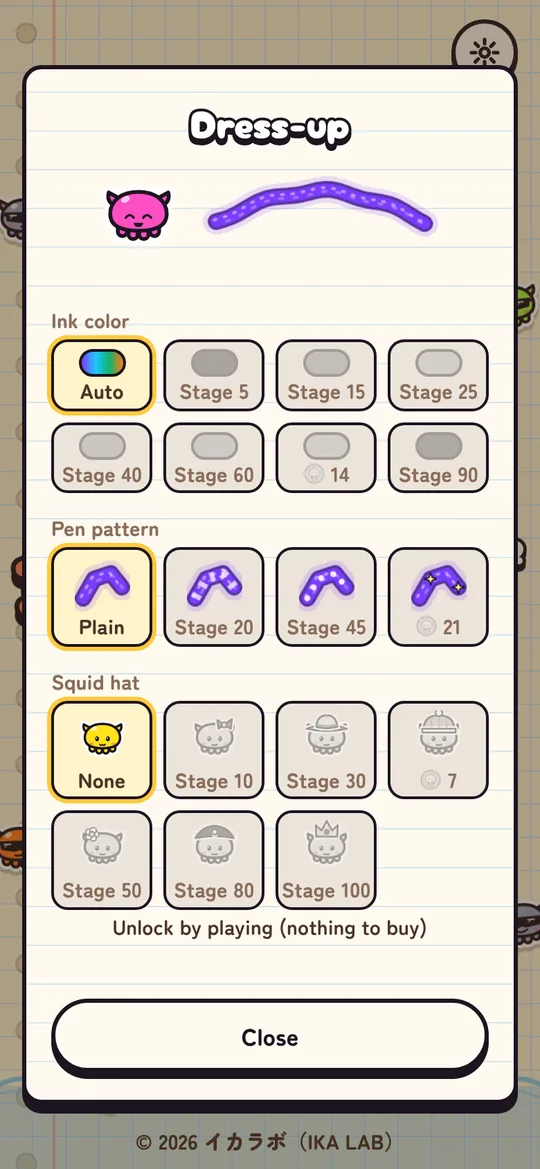
Dress-up items unlock with the number of stages you've cleared and the number of Daily stamps. The conditions are shown on the Dress-up screen from the start, and there is nothing to buy. Here is what unlocks when:
- Ink color: Ink at 5 stages cleared, Berry at 15, Sky at 25, Leaf at 40, Orange at 60, Night at 90; Gold at 14 stamps
- Pen pattern: Stripes at 20 stages, Dots at 45; Sparkle at 21 stamps
- Squid hat: Ribbon at 10 stages, Straw at 30, Flower at 50, Pirate at 80, Crown at 100; Beanie at 7 stamps
How Bonus and Daily stages differ
The Bonus stages 101 to 200, which start after you guard all 100 stages, are stages 1 to 100 in the same order, mirrored left to right. You get less ink than in the original: most stages have 0.85 times as much, and some later ones 0.86 to 0.96 times. Compared with the hint line, that's about 1.12 to 1.45 times, so some are tougher than the late main stages. The IQ tag climbs from 201 to 300.
Bonus stages don't show the illustrated tips or example lines for new gimmicks, but the hint line after three fails and your last line still appear. The sticker book grows to 20 pages, and the Bonus pages have their pictures flipped.
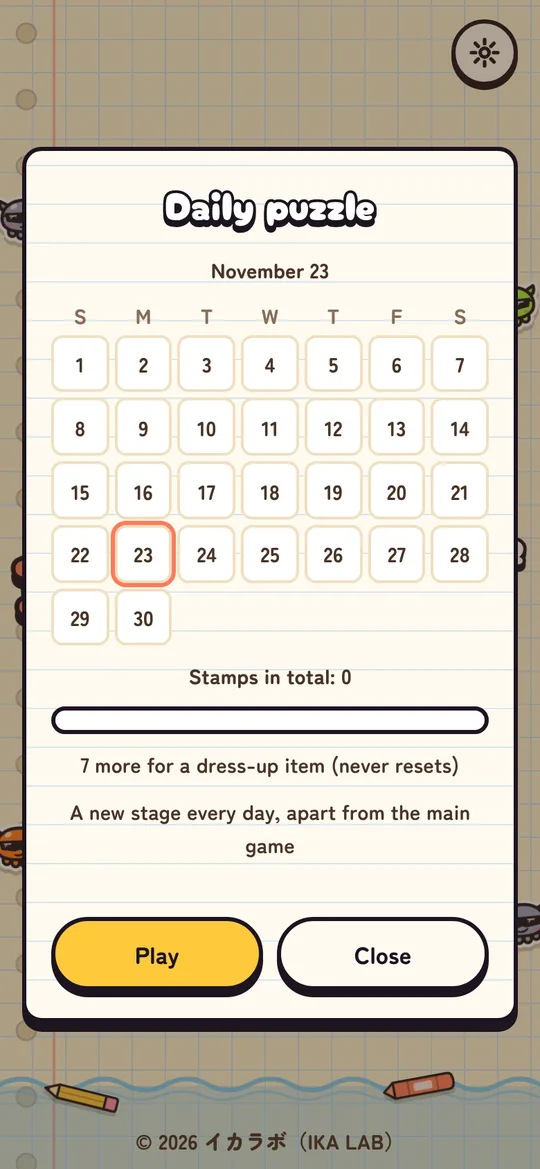
The Daily puzzle is one stage chosen by the date on your device. It comes from a set of 60 stages and goes through all of them every 60 days. They are based on stages 18 to 99: about half are mirrored, and most have different shady squid types coming out of the shells. There are no boss stages, and 14 of them use two lines. Ink and defense time (8 to 12 seconds) match the original stage, and the IQ tag is 150 to 209.
Clearing it gives you a stamp. You get one stamp per day, but you can keep playing with “Play again” after clearing, and it doesn't change your main-game progress. Stamps are counted as a total, so taking a few days off never resets them to zero. Since you can replay it as often as you like, the Daily is the place to shrink your Least ink record.


