IKADOKU Advanced Guide: Later Boards, the Tips Each Mode Needs, Reading Hints, and How ★ and IQ Work
Our solving guide covered the basics of IKADOKU: using × marks, spotting one-cell colors and two colors in two rows, the "what if" idea, and when to use hints, the Squid Ink Boost and meteors. This advanced guide goes further. When do the boards get bigger? Which Tips does each mode really need? What is a hint message telling you? And how are ★ and IQ decided? We made the game, so we checked how it works inside and put it all here.
Later boards: when the size changes
Board size is set by the mode and the level number, and boards get bigger as you go.
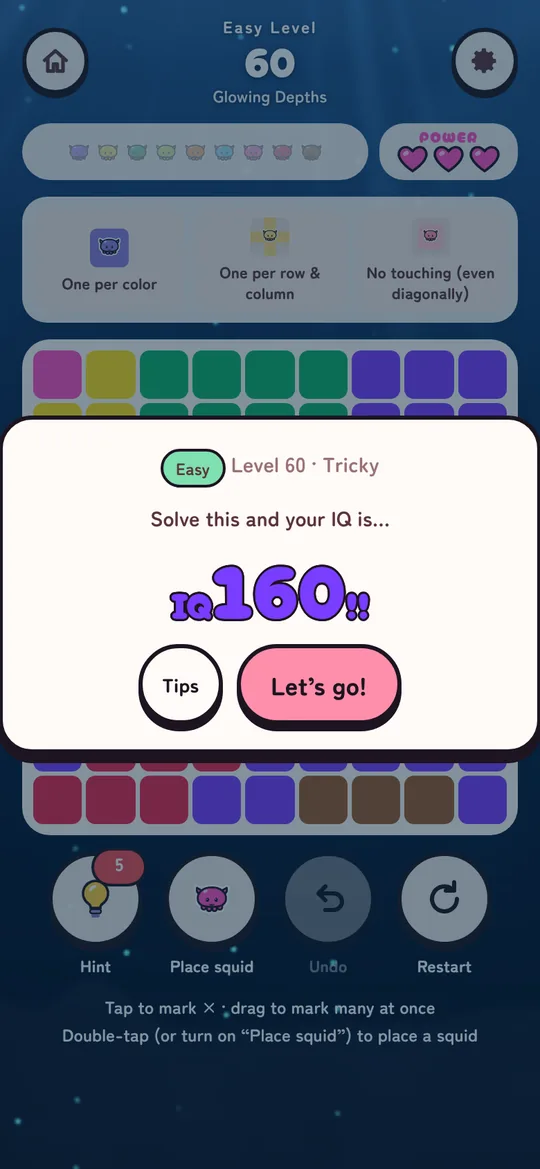
From Easy Level 31 on, the game builds each puzzle from the level number. The recipe is fixed for each number, so everyone who plays the same level gets the same puzzle. There are three kinds of target. Levels ending in 0 are "Tricky", and the card before the level says "· Tricky". Levels ending in 3, 6 or 9 aim for a puzzle that takes a few more steps. The rest are meant to flow smoothly. All three kinds get slowly harder on the way to Level 1000.
Here is where the size changes:
- Easy: Levels 1–30 are hand-made practice boards (5×5 to 9×9). Levels 31–59 are 8×8, except 40 and 50, which are 9×9. From 60 on, every board is 9×9
- Normal: Levels 1–150 are 8×8, 151–500 are 9×9, and from 501 they are 10×10
- Hard: Levels 1–200 are 9×9, 201–800 are 10×10, and from 801 they are 11×11
Which Tips does each mode need?
The game's "Solving tips" pages list Tip 1 to Tip 7. We had the same logic that powers the hints solve every level from start to finish, and counted the hardest Tip it needed along the way.
Some spots can be solved with other ideas too, so treat these as a guide. Even so, it is clear that late Normal and Hard come down to whether you can use Tip 7. If a "Tricky" level in Easy slows you down, that is a good chance to practice Tips 3–5. Before Normal, look over Tips 5 and 6 again, and before Hard, Tip 7.
- Easy: 403 levels can be finished just by repeating "this is the only spot left". 583 need up to Tip 2, and 14 need up to Tips 3–5. All 14 of those were "Tricky" levels
- Normal: every level needs something at the Tips 3–5 level or above. 383 of the 1,000 need Tip 7. In Levels 1–100 only one does, but in 901–1000, 89 do
- Hard: 997 of the 1,000 levels need Tip 7. The other 3 still need Tip 6
Reading a hint message
A hint uses pure logic to find the next squid that is forced by the current board, and places it. The Tip number in the message is the hardest idea needed to get there.
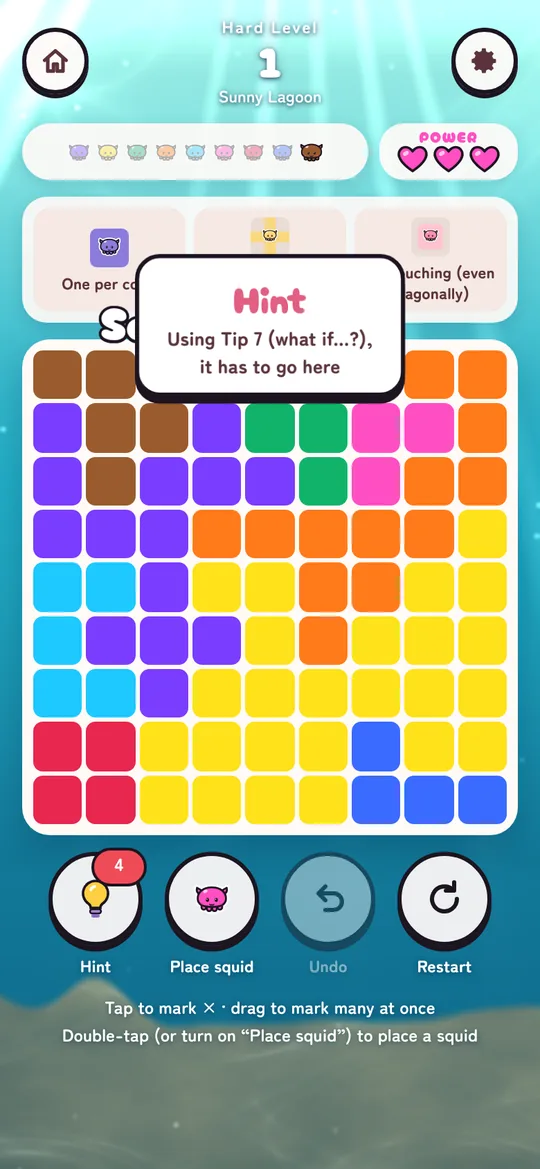
One thing worth knowing: hints do not look at the × marks you added. They only use the squids already on the board. So even if your × marks have narrowed things down a lot, you may still see a high Tip number. Read it as "starting only from the placed squids, this spot needs this Tip", and compare it with your own marks. Also, if the hint's cell has an × on it, the squid still goes there.
A squid placed by a hint never counts as a miss. Your praise word still climbs one step, and you can still aim for a no-miss clear.
There are five kinds of message:
- "This row, column or color has only this spot left" — no Tip number (the easiest)
- "Using Tip 2 (a color inside one row), it has to go here"
- "Using Tips 3–5 (cells left, two colors in two rows), it has to go here"
- "Using Tip 6 (colors packed into rows), it has to go here"
- "Using Tip 7 (what if…?), it has to go here"
★ (no misses) and the praise ladder
If you clear a level without a single miss, you see "No misses!" and that level is recorded as a no-miss ★. Your ★ count across all three modes is shown as "No-miss ★" on the Records screen. If your first miss turned into "Safe!", or you ran out of POWER and chose "Watch an ad to continue", the miss still counts, so there is no ★.
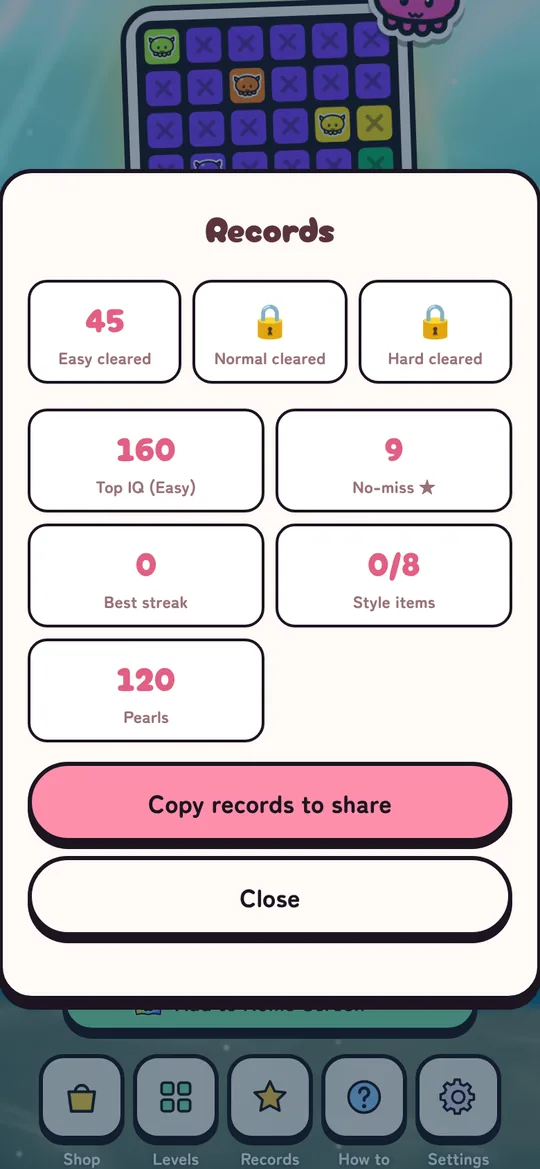
You can earn a ★ later, too. Replaying a level you already cleared gives only 1 pearl, but a no-miss replay adds 5 pearls and the ★. So you can push ahead first and come back for ★ once you are more confident.
Praise words climb one step with each correct squid, and drop back to the bottom when you miss (even a "Safe!" miss). With the default "Squid puns" set, the five steps are "Squid-cool!", "Squid-tastic!", "Ink-credible!", "Squid genius!" and "Squid legend!", and after that it stays on "Squid legend!". Place the last squid with no misses and the final word becomes "Squid-perfect!". Under "Praise words" in Settings you can switch to Streamer, Cool English, Standard or Off.
A helper for Hard: auto-× around squids
You can't use the Squid Ink Boost in Hard. But Settings has a switch called "Auto-mark × around squids". Turn it on, and each time you place a correct squid, × marks are added to every empty cell in the same row, the same column, the same color and the 8 cells around it. It starts off.
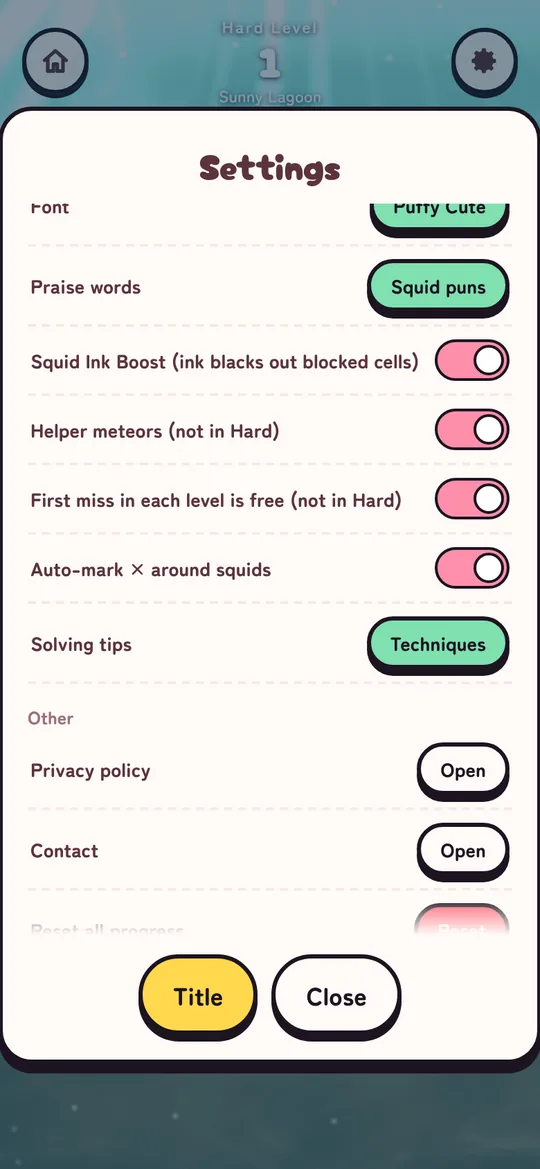
This switch only appears in Settings when the Squid Ink Boost is not working. While playing a Hard level, open Settings with the gear at the top right and you will find it. In Easy and Normal, it also appears if you turn the Squid Ink Boost off.
Since you add fewer × marks by hand, you can focus on thinking through Tips 6 and 7. Hard is just you and your brain, but it is still smart to use what you can and save your thinking time.
How IQ works, and the milestone every 100 levels
IQ appears on the card before each level, next to "Solve this and your IQ is…", and when you clear it you see "IQ ○○! Well done!". The number depends only on the mode and the level number. Misses and time do not change it.
Every 100th level brings a milestone card. The first time you clear one, you get a 50-pearl bonus. Level 1000 of Easy or Normal gives 200 pearls, and Level 1000 of Hard gives 500 pearls with a special "IQ 300 class!" card. From a milestone card or the clear screen you can share the answer to that board. Everyone gets the same puzzle for the same mode and level, so you can compare answers with friends. Only the Daily Ikadoku keeps its answer secret and shares your result instead.
A higher mode never shows a lower IQ than the mode below it. "Top IQ" on the Records screen is the IQ of the furthest level you have cleared in the mode you have selected. As the game itself says, this IQ is just a fun difficulty number. It does not measure real intelligence. Here is the IQ range for each mode:
- Easy: Level 1 is 102. It goes up by 2 each level to 160 at Level 30, then rises slowly to 180 at Level 1000
- Normal: Level 1 is 180, Level 1000 is 249
- Hard: Level 1 is 250, Level 1000 is 300


