IKA BLOCK Guide: Rescue Squids Faster and Never Run Out of Room
IKA BLOCK is a puzzle where you place blocks on an 8×8 grid and clear full lines. It may look like a game of luck, but there are clear rules behind how blocks are dealt and how they clear. As the makers at IKA LAB, we explain how to use those rules to get through levels, handle special blocks and push your score higher in Endless.
The three blocks are dealt so that all of them fit
The three blocks at the bottom aren't picked at random. They're chosen so that all three can fit on the board as it is when they're dealt (if no such set can be found, you get small blocks instead). In other words, most dead ends come from the order and spots you choose after the deal.
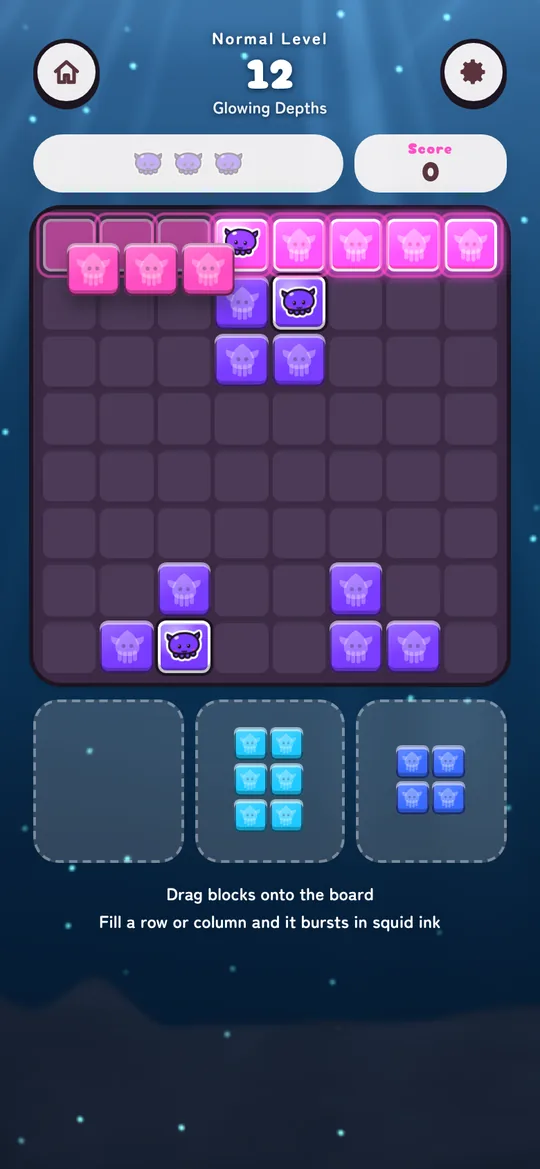
So before placing the first one, work out where all three will go. Placing big blocks, or blocks with few possible spots, first makes it less likely you'll be stuck later. Blocks can't be rotated, so look carefully at their shapes before deciding.
While dragging, a colored shadow appears when the block is over a valid spot, and any lines that will be completed light up in the block's color. With touch controls, the block is shown a little above your finger, so place it by watching the shadow, not your fingertip.
In levels, plan from the lines with squids
In levels, the goal isn't points: you clear a level by rescuing every squid block. A squid is rescued when you clear the row or the column that contains its cell.
Before you start, check for each squid whether its row or its column will fill up sooner. Pick the one with fewer empty cells and you'll rescue it in fewer moves. If two or more squids share a line, make that line your top priority.
Clearing lines without squids matters too, because the more open the board is, the easier it is to fit big blocks when they come. While building toward the squid lines, try to keep your empty space gathered in one area instead of scattered all over the board.
How to use shells, rocks and ink bombs
Shell: the first clear cracks it and turns it back into a normal block; a second clear removes it. A squid inside a shell is only rescued on the second clear, so either fill the same line twice or use two different lines, like the row first and then the column.
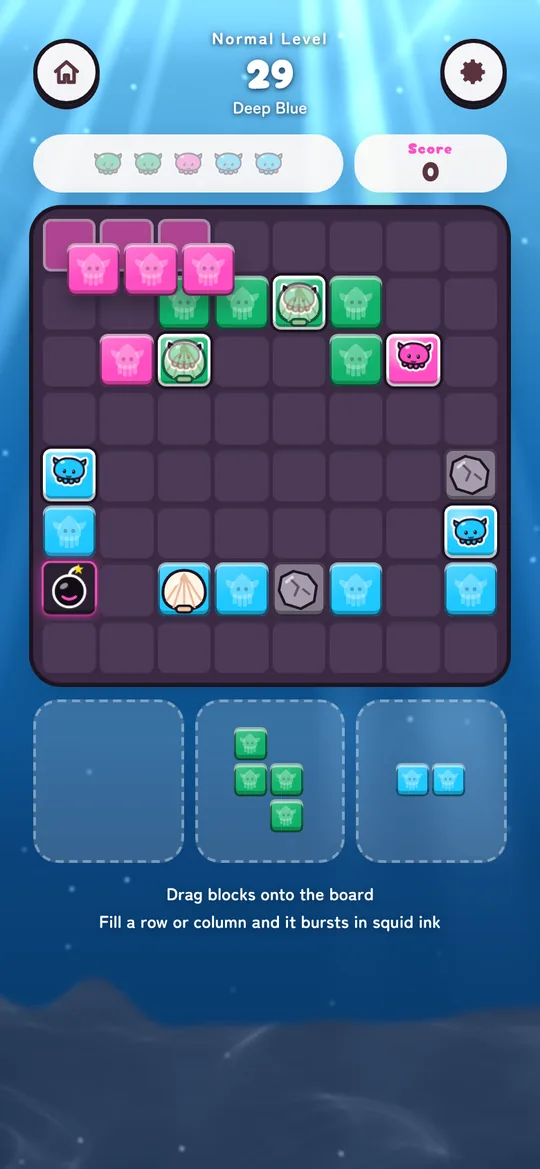
Rock: it never clears and you can't place blocks on it, but it counts as one cell when completing a line. A line with a rock fills faster because it has fewer empty cells, so it can actually help. But the rock stays after the clear, so that cell is blocked for good.
Ink bomb: clear a line with a bomb in it and the 3×3 area around the bomb clears too. If another bomb is caught in the blast, it explodes as well. Squids in the blast are rescued all at once, and shells get cracked. Only rocks survive an explosion.
Special blocks first appear in Easy at level 12 (shells), level 25 (rocks) and level 40 (ink bombs). In Normal, shells and ink bombs appear from level 1 and rocks from level 5. In Hard, all of them appear from the start.
How points and combos work
Placing a block scores one point per cell. Clearing lines scores the number of lines times itself times 10: 10 points for one line, 40 for two at once and 90 for three at once, so clearing together grows fast.
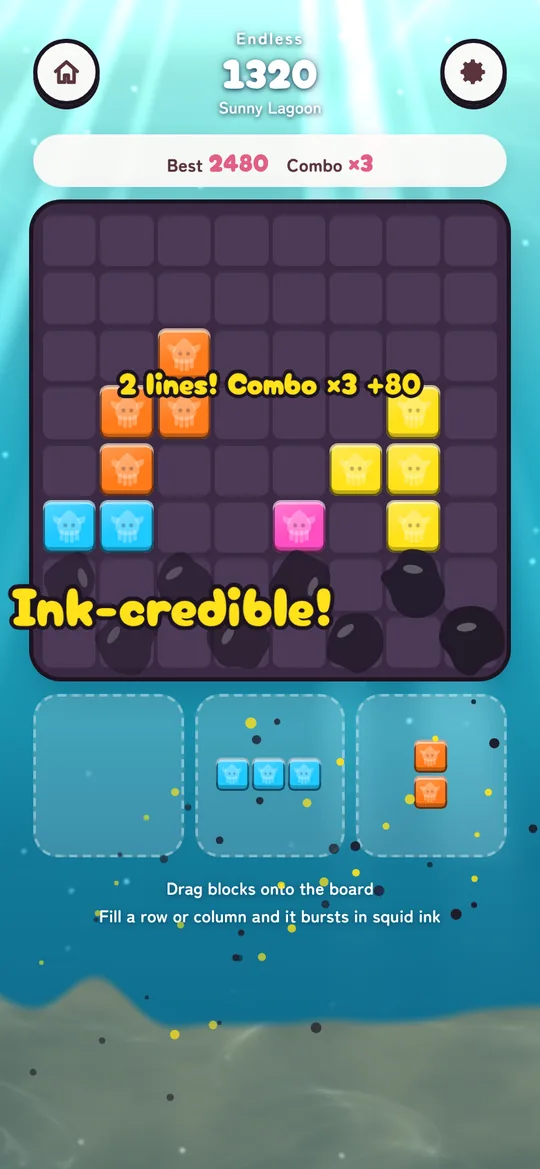
Each clear also keeps a combo going. The combo breaks after three placements in a row without a clear. From the second combo on, you get a bonus of (combo count minus 1) × lines cleared × 10 points, plus 20 points for every ink bomb that explodes.
For example, clearing two lines at once on the third combo gives 40 points plus a 40-point bonus, for 80. To raise your score, keep up a pace of clearing something at least once every three moves, and now and then clear two or three lines together.
Help when you're about to run out of room, and why Hard is tough
When none of your blocks fit, Easy and Normal swap them for small blocks that do fit, once per attempt. Hard has no such safety net.
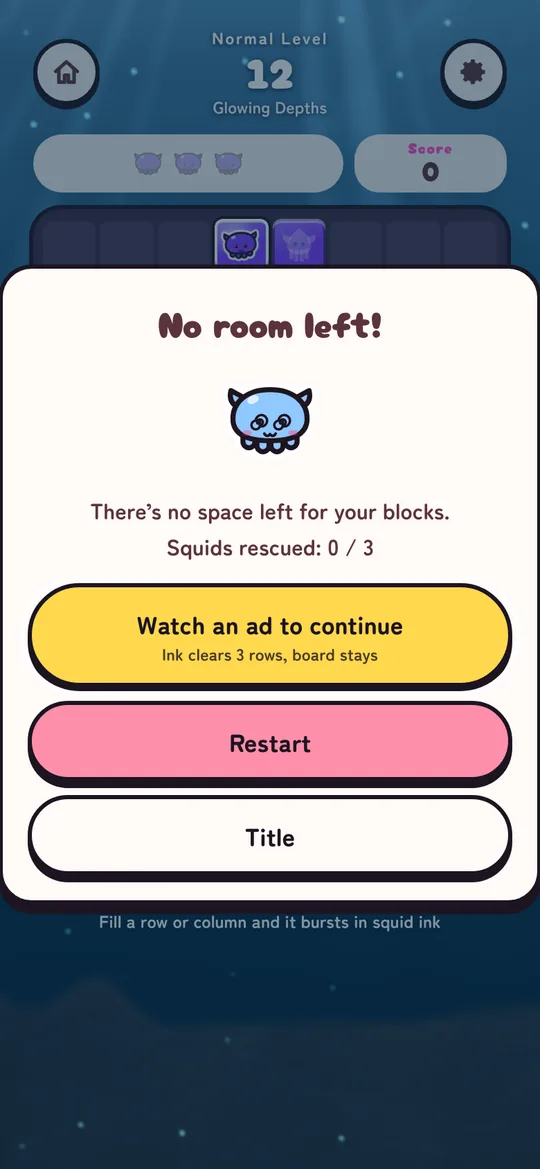
If you're stuck again after that, you can watch an ad to continue. This clears the three rows with the most blocks, but rows without squids are chosen first. So continuing won't rescue squids for you; use the freed-up space to rebuild your squid lines. Rocks stay, and shells only crack.
Choosing Restart lets you replay the same level from the beginning. A level's starting board is the same every time, while the blocks you're dealt change each time. Remember the board where you failed and try clearing the lines in a different order; that often gets you through.
How the modes open up, and tips for Endless
Easy, Normal and Hard each have 1,000 levels. Clearing 100 levels in Easy opens Normal, and clearing 100 in Normal opens Hard. The first 10 levels of Easy are practice levels that teach one placement idea at a time. Every 10th level is a little tricky and every 100th is a boss level, and we made the levels right after a boss, and the first few levels with a new special block, a bit calmer.
As the difficulty goes up, more big blocks are dealt and fewer line-friendly shapes are mixed in. To win in Hard, always keeping a gap open for big blocks becomes even more important.
Endless is a high-score mode you can play anytime. The higher your score, the more big blocks appear, and the sea scenery in the background changes every 1,500 points. Endless has no safety net and you can continue with an ad only once, so keep wide gaps open from the very start. Under Records on the title screen you can see your clears per mode, your Endless best, squids rescued and lines cleared.


