IKA GOLF Advanced: The Width of the Impact Zone, Carry and Roll, Wind in Numbers, How Fast a Ball Can Still Drop, and the Tricks and Golf IQ Tables
Our IKA GOLF guide covered the two-tap swing, how far each club flies, reading wind and slopes, and the tricks on each course. In this advanced guide, we at IKA LAB take a closer look at the numbers inside the game: how wide the impact zone is, what a shot's distance is made of, how far wind moves the ball, how fast a ball can be going and still drop, the numbers behind the tricks, and how the praise words and Golf IQ are decided.
You can count the impact zone in pixels
The game screen is 160 pixels wide, and the Impact line sits at the left end of the power bar. Tap within 2 pixels of the line and you get Just impact!, within 6 pixels it is a Nice shot!, and within 14 pixels the ball only hooks or slices a little. The colored bands around the line match this: pink in the middle is Just, the mint band outside it is Nice, and pale yellow is the "curves a little" zone.
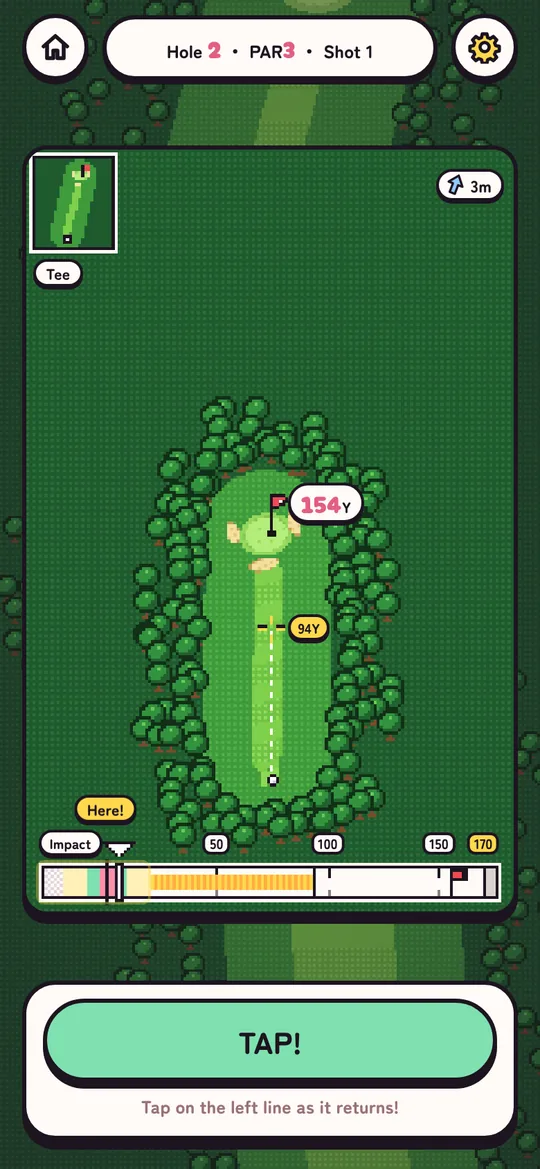
With the Driver and the 5 Iron, the returning ▼ moves 80 pixels per second; with the Putter it moves about 59. Just covers 2 pixels on each side of the line, a width of 4 pixels, so you have about 0.05 seconds to hit it with the Driver and about 0.07 seconds with the Putter. While you build power, the ▼ takes 1 second to reach MAX with the Driver and the 5 Iron, 1.05 seconds with the 9 Iron, 1.1 seconds with the Sand Wedge and 1.35 seconds with the Putter.
Only a Just impact adds 3% to the distance, for every club except the Putter. When you miss the line, the ball moves sideways by 1.2% of its carry (the distance it flies through the air) for each pixel you are off. With a 200-yard carry, that is about 5 yards for a 2-pixel miss, about 14 yards for 6 pixels and about 34 yards for 14 pixels. The Putter does not curve; instead, each pixel turns the direction of the putt by 0.4 degrees.
Distance is carry plus roll
Every shot is split into carry, the part in the air, and roll, the part after it lands. With no wind and a landing on a flat fairway, roll makes up 12% of the total for the Driver, 8% for the 5 Iron, 6% for the 9 Iron and 4% for the Sand Wedge. How much speed the roll starts with depends on where it lands: taking the fairway as 1, the green gives 1.1 times, the fringe 0.8, the rough 0.3 and ice 1.8. On ice, the force that slows the ball is also only 0.22 times the usual, so as long as the ball keeps rolling on ice, the roll gets much longer still. A ball that lands in a bunker or a swamp stops right there, and a ball that rolls into one stops there too.
The yards shown in the message after a shot are this carry plus the roll for the ground where it landed.
The ground you hit from changes the distance as well. The number at the right end of the power bar is the MAX with your lie already included. The MAX on the club button at the bottom right does not include the lie, so from the rough or a bunker, read the number on the bar. For every club except the Putter, the numbers compare each lie with the fairway; for the Putter, they are shares of the Putter's own MAX of 30 yards:
- Rough: 0.95 times for the Sand Wedge, 0.85 times for the other clubs
- Bunker: 0.9 times for the Sand Wedge, 0.5 times for the other clubs
- Swamp or chocolate: 0.75 times for the Sand Wedge, 0.55 times for the other clubs
- Putter (share of its 30-yard MAX): 1 from the green, 0.85 from the fringe, 0.75 from the fairway, 0.5 from the rough, 0.35 from a swamp and 0.3 from a bunker
Wind only moves the carry
When a hole starts, the wind strength is picked in whole meters from that hole's range, and the direction can be any way at all. Once it is set, it does not change for the rest of the hole. Most holes are 1 to 3 m. The strongest is hole 6 at Gull Cape, at 5 to 7 m, and hole 4 at Squid Woods and hole 5 at Cactus Desert are 4 to 6 m. Moon Craters and Under the Sea have no wind, and the Night Course is 0 to 2 m.
Wind only changes the carry, never the roll. For a shot with a 200-yard carry, a head or tail wind moves the landing spot about 2.2 yards per meter, and a crosswind about 1.8 yards per meter. The effect grows with the length of the carry, and for the Sand Wedge alone it is 1.3 times bigger again. For example, a full Driver with a Just impact carries about 208 yards; into a 3 m wind straight against you it lands about 7 yards short, and with 3 m from straight to the side it lands about 6 yards off line. The red flag on the power bar is worked out without the wind.
Green slopes and how hard a ball can drop
Sloped greens appear on holes 7 to 10 at Squid Woods, holes 1, 4, 9, 10, 15, 17 and 18 at Gull Cape, holes 8 and 10 at Cactus Desert, and holes 6 and 10 at Babbling Valley, Frozen Snowfield, Fire Volcano Isle and Moon Craters. Every green on the 10 courses from Mushroom Forest onward is flat. Even on the steepest, hole 10 at Gull Cape, the slope pushes with only about a third of the force that slows a rolling ball, so a ball never keeps rolling forever on a green.
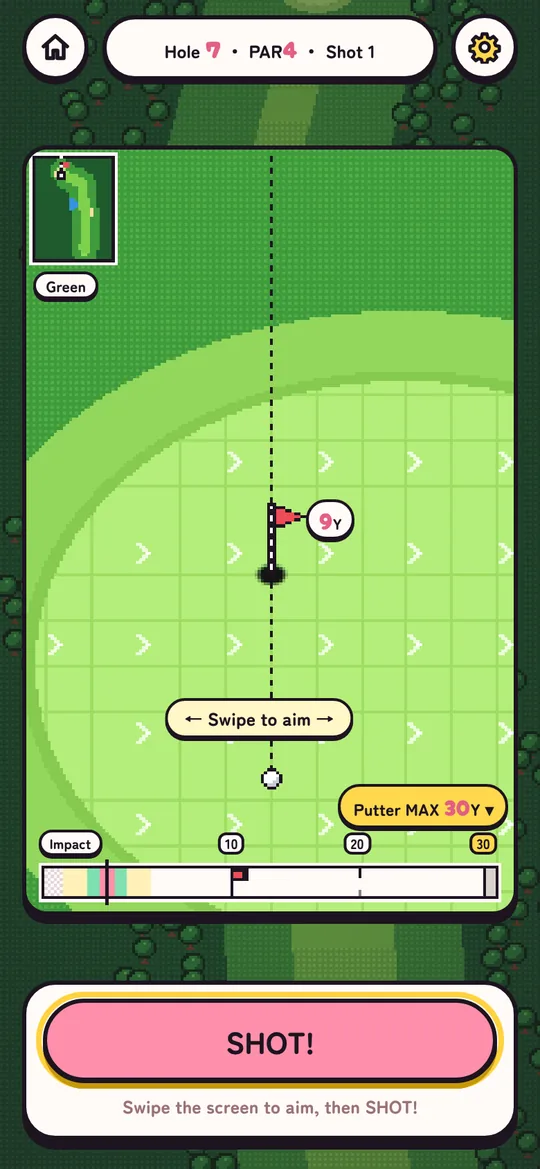
When you putt, the red flag marks the power that would stop the ball 0.8 yards past the cup. A ball drops when it passes within 0.6 yards of the center of the cup and has slowed down enough that, on a flat green, it would stop within 4.5 yards from there (within 6 yards for shots other than putts). Any faster and it runs right over the cup.
When a shot other than a putt lands within 0.7 yards of the cup, you get SLAM DUNK!; when it rolls in, you get CHIP-IN!; and when you hole a putt, you get IN THE CUP!
The tricks in numbers
On Moon Craters, the MAX of every club except the Putter is 1.5 times bigger, and Under the Sea it is 1.2 times bigger. The Putter stays the same. Hole lengths are built to match: divide the length along the fairway by 1.5 (1.2 under the sea) and PAR 3 holes are up to 250 yards, PAR 4 holes 251 to 470 yards and PAR 5 holes 471 to 690 yards. The PAR 6 holes of Squid Continent start at 691 yards.
Land on a bounce mushroom and the ball flies 55, 64 or 95 yards in a direction set for that mushroom. If it lands on another mushroom it bounces again, up to 3 times, and the roll after a bounce is cut in half. A torii ring warps the ball not only when it lands within 6 yards of the ring's center, but also when it rolls into the ring.
On ice, the force that slows the ball is only 0.22 times the usual amount. On currents and conveyor belts the ball never stops: it speeds up or slows down to match the flow and is carried until it leaves it. A belt counts as fairway, so the ball does not fall even if there is a pit underneath.
Praise words and the Golf IQ cut-offs
Every Nice shot or better, meaning within 6 pixels, and every hole-out move the praise word up one step: Squid-cool!, Squid-tastic!, Ink-credible!, Squid genius!, and from the fifth step on, Squid legend! It goes back to the start after a shot that is more than 6 pixels off (duffs included) or a pond or OB that was not saved, and also at every new hole. A miss that the save turned into "no shot" does not count. If you hole out without any miss of more than 6 pixels and without an unsaved pond or OB on that hole, you get Squid-perfect!
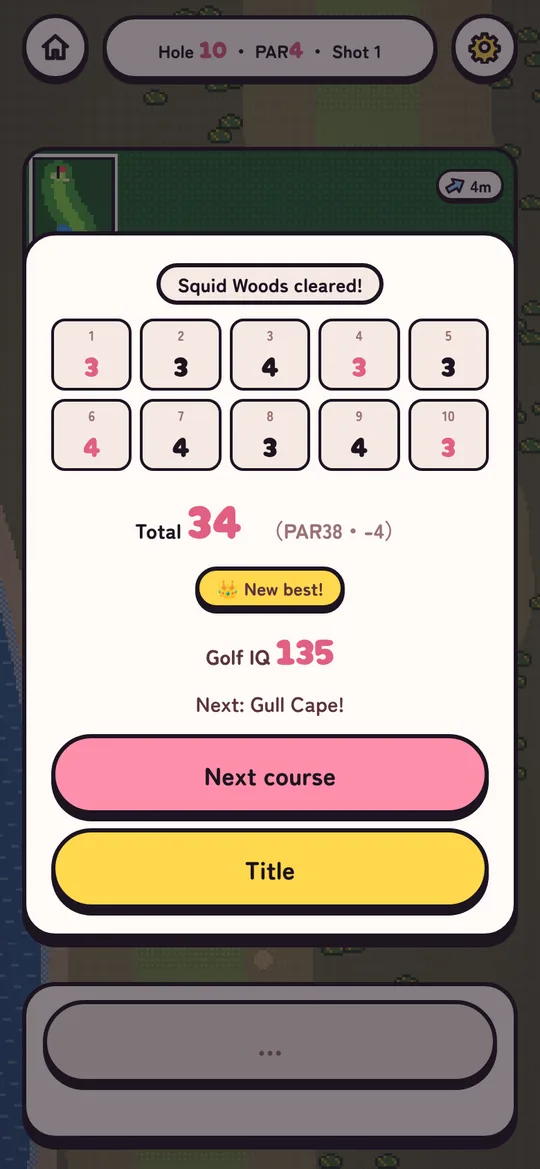
The Golf IQ for a hole is 100 for par, 120 for one under, 140 for two under, 160 for three or more under, 90 for a bogey and 80 for anything worse. A hole in one on a PAR 3 is two under, so it gets 140.
The Golf IQ for a course comes from the difference between your total and par. On a 10-hole course, -8 or better gives 150, -4 or better 135, 0 or better 120, up to +5 gives 105, and anything more gives 90. On Gull Cape, which has 18 holes, the cut-offs are 1.8 times bigger: -15 or better gives 150, -8 or better 135, 0 or better 120 and up to +9 gives 105.


