IKA GOLF Strategy Guide: Impact Timing, Judging Distance and Every Course's Tricks
IKA GOLF lets you hit a shot with just an aim and two taps. Because swinging is easy, the difference between scores comes down to where you tap and how much power you use. In this guide we, the makers at IKA LAB, explain how impact timing bends the ball, how to judge distance, how to read wind and slopes, and how to think about the tricks on each of the 17 courses, with real numbers where they help.
How the two taps work, and reading your misses
Swipe the screen left or right to aim, press SHOT!, and a ▼ marker runs to the right along the bar at the bottom. Your first tap sets the power. If you don't tap and the marker comes all the way back, the shot is simply cancelled and no stroke is added.
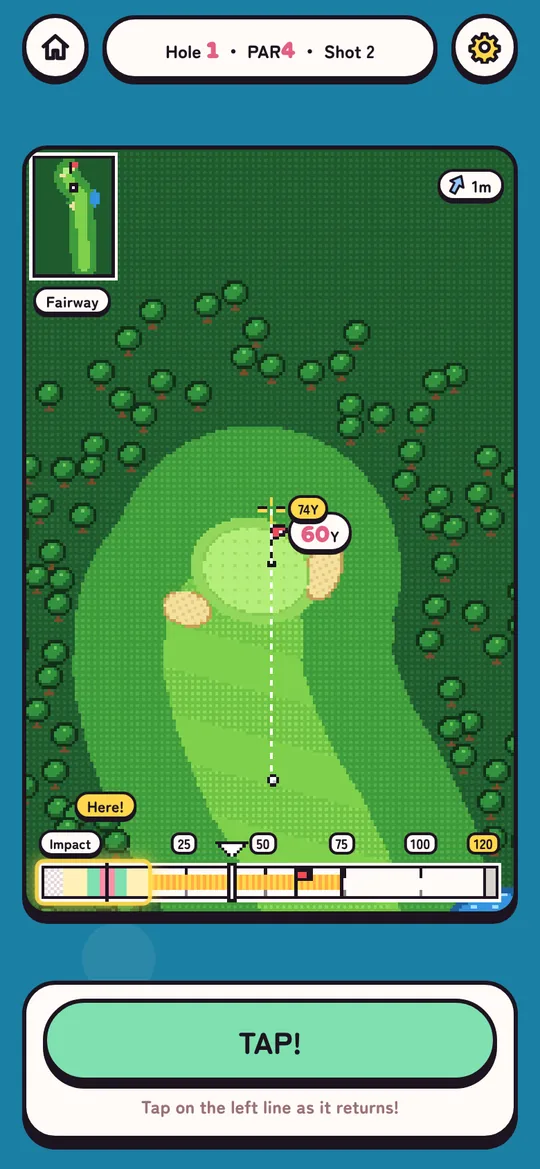
Once the power is set, the ▼ comes back toward the Impact line on the left. If your second tap lands right on that line, it's a Just Impact: the ball flies straight and a little farther. A small miss still counts as a nice shot. Tap before the line (too early) and the ball curves left; tap after it passes the line (too late) and it curves right. The bigger the miss, the bigger the curve. If you never tap and the ▼ reaches the left end, you duff it and the ball barely moves.
After each shot, a message tells you whether it hooked left or sliced right. If you keep curving the same way, think about whether you're tapping too early or too late and adjust. With the putter, the gauge moves more slowly and you can aim in finer steps.
Judging distance: MAX and power
There are five clubs. From a normal lie at full power, they carry roughly: Driver 230 yards, 5 Iron 170, 9 Iron 120, Sand Wedge 70 and Putter 30. Distance is about MAX × power. For example, if the cup is 60 yards away with a 9 Iron, tap at about half the bar. The power bar has yard marks on it, so use them to pick where to tap.
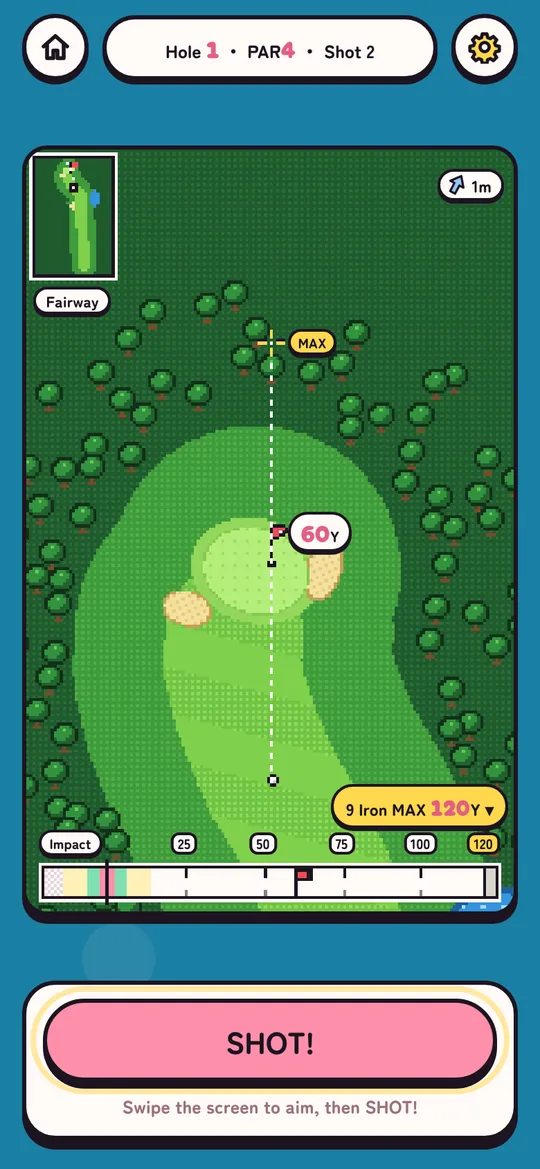
The game picks a club automatically based on distance and lie, and you can tap the club display on the right, just above the power bar, to change it while seeing the recommended one. The MAX shown there doesn't include the ground you're on; the number at the right end of the power bar shows the distance adjusted for your ground.
- In the rough, the ball flies a bit shorter and rolls less after landing
- In a bunker, the Sand Wedge flies almost normally, while other clubs go only about half as far
- On the green, the ball rolls a little farther
Wind and green slopes
The arrow and number at the top right show the wind. A tailwind adds distance, a headwind drops the ball short, and a crosswind pushes it sideways. The longer the shot, the more the wind moves it, and the Sand Wedge catches a lot of wind for how short it flies. On windy holes, aim a little into the wind and adjust your power for head- or tailwind. Wind doesn't affect the putter, and the wind display hides while you putt.
When a green has a slope, the ball bends in the direction of the arrow. The basic rule is to aim a little to the side opposite the arrow, not straight at the cup. On very steep greens, you may need to aim much farther off than you'd expect. If the ball stops right beside the cup, you get a gimme: it counts as holed with one more stroke.
Cutting mistakes and penalties
On each hole, your first big mistake is safe, just once. A badly curved shot or a duff is treated as if you never swung, and a ball in water or out of bounds is replayed with no penalty. But you only get one safe per hole, whichever comes first. After that, water and OB cost a 1-stroke penalty and you replay from where you hit.
Some holes look like the cup is straight ahead of the tee, but the fairway bends on the way. Your aim starts out pointing at the cup, so hitting it as is may land you in the rough or OB. Check the shape of the hole on the map at the top left and aim for the wide part of the fairway first.
If your strokes reach twice the par plus two, the hole ends there. Rather than forcing a shot straight at the cup, landing safely on the fairway and green usually leads to a lower total.
Beating the tricks on each course
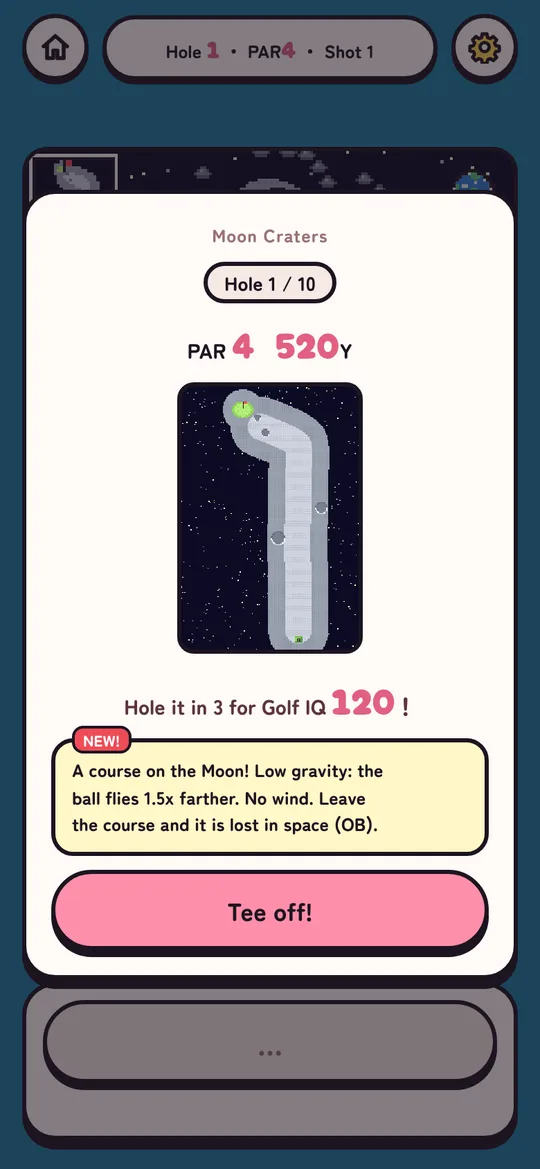
On every course, the first hole where a new trick appears shows a short explanation at the start. Here's what each one does and how to think about it.
- Gull Cape: the sea works like a pond, with a 1-stroke penalty, and the beaches play like bunkers. It's the only course with 18 holes
- Frozen Snowfield: frozen ponds carry no penalty, but the ball slides and is hard to stop. Unfrozen streams do cost a penalty, so tell them apart
- Fire Volcano Isle: lava works like a pond, with a 1-stroke penalty. Black sand is a bunker
- Moon Craters: low gravity makes the ball fly 1.5 times farther, and there's no wind. Off the course is OB into space, so go easy on power
- Mushroom Forest: land on a red bounce mushroom and the ball springs forward. You can use it to clear ponds
- Sakura Road: stop the ball inside a red torii ring and it warps near the green
- Candy Island: chocolate swamps stop the ball dead, and your next shot won't go far (the Sand Wedge handles it better)
- Under the Sea: the ball flies 1.2 times farther, with no wind. Currents carry a rolling ball along
- Night Course: only the ball and the lanterns are lit. Check the shape on the map at the top left
- Above the Clouds: fall through a gap and it's OB. Gadget Factory: conveyor belts carry the ball. Jungle: narrow paths with many rivers and swamps
- Squid Continent: a long course where every hole is par 6. Chain three drives and you can aim to hole out in 5. Rainbow Island: every trick so far shows up
Unlocking courses and Golf IQ
You start with two courses: Squid Woods and Gull Cape. Play both to the last hole and Babbling Valley opens; after that, each time you finish a course, the next one opens. Your best total for each course is saved, so you can keep improving on a course even after moving on.
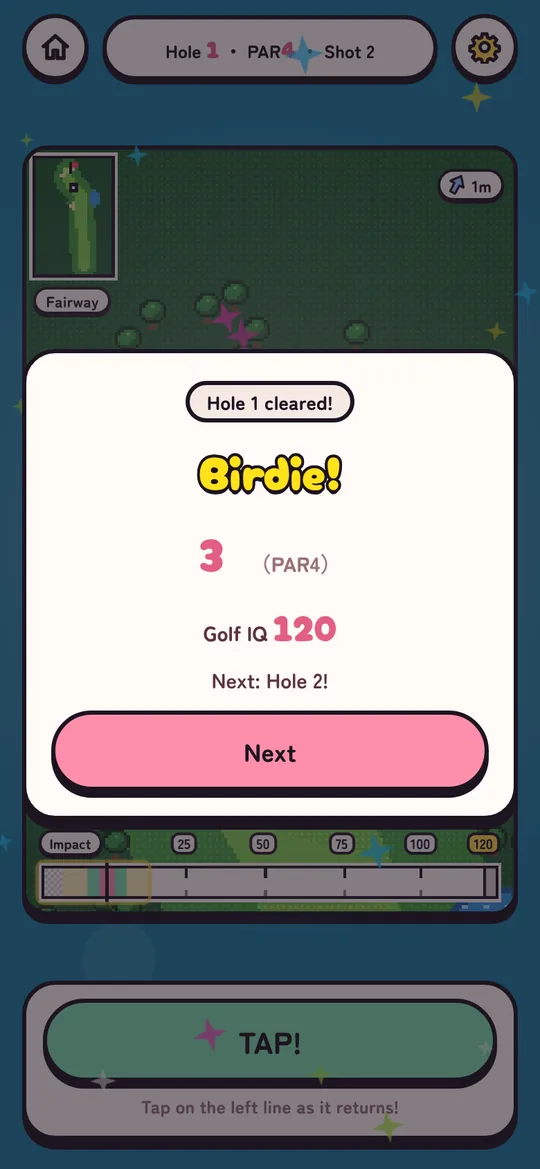
After each hole you get a Golf IQ: par is IQ 100, a birdie is 120, an eagle is 140, and anything better is 160. When you finish a course, you also get a Golf IQ for the whole round, based on your total against par. Start by aiming for steady pars, then, once you're comfortable, go for birdies on short par 4s or with a tailwind.


